ERRU is back for UK hauliers: how EU infringements now reach your Operator's Licence
A missed manual entry after the weekend. A start country that was never entered. A break taken ten minutes late. Small slips, but once a driver is fined for them at a roadside check in France or the Netherlands, they no longer stay abroad. Since 1 January 2026 the UK has been reconnected to ERRU, the European network that tells a haulier's home country about serious infringements. For UK operators working in the EU, that changes the picture.
Operator's Licences are rarely lost over one big offence. They are lost because small mistakes pile up week after week and nobody can show how they were dealt with. By the time a case reaches a Traffic Commissioner, the question is not whether there were infringements. It is what you did about them.
What is ERRU, and why does it matter again?
ERRU stands for the European Register of Road Transport Undertakings. It links the national registers of road transport operators so that enforcement bodies can share information on serious infringements and on transport managers who have lost their good repute. In effect, it is a cross-border record for hauliers.
The UK was disconnected on 31 December 2020. It reconnected from 1 January 2026 under the UK-EU Trade and Cooperation Agreement, with S.I. 2025/1202 giving effect to this in UK law. The government's explanatory memorandum is blunt about what that means:
“In practical terms, infringements committed by UK operators when working in the EU will be more easily reportable to the UK enforcement and regulatory authorities via ERRU, which may result in non-compliant operators facing quicker enforcement action.”
In Great Britain, two bodies are involved:
- DVSA carries out roadside checks and investigations, issues fixed penalties and reports its findings to the Traffic Commissioners
- The Traffic Commissioners decide on Operator's Licences and on the good repute of operators and transport managers
Which infringements count?
Not every slip ends up in front of a Traffic Commissioner. Regulation (EU) 2016/403, as assimilated into GB law, sorts serious infringements into three levels, and the same categories are now used for the UK-EU exchange through ERRU:
- Serious infringement (SI)
- Very serious infringement (VSI)
- Most serious infringement (MSI)
The scope goes well beyond the tachograph. Drivers' hours, overloading, roadworthiness, dangerous goods and missing documents all feature.
The most serious infringements are listed in Annex IV of Regulation (EC) 1071/2009, and the Senior Traffic Commissioner's Statutory Document 1 reproduces them. For drivers' hours and tachographs they include:
- exceeding the maximum 6-day or fortnightly driving time limits by 25% or more
- exceeding the maximum daily driving time limit by 50% or more without a break or a 4.5-hour rest
- having no tachograph, using a fraudulent device, or falsifying tachograph or driver card data
- driving with a falsified driver card, or with a card of which the driver is not the holder
Only once the penalty is final
What counts is a conviction or a penalty, not a flag in your own tachograph analysis software. An infringement that only shows up in your weekly reports is a management issue, not an ERRU entry. ERRU deals with penalties arising from roadside checks, investigations and checks at operators' premises.
Fines abroad now come home
This is the part that has changed. When a UK driver is penalised for a serious infringement in an EU member state, that country can now report it to the UK through ERRU. Statutory Document 1 already allows Traffic Commissioners to take into account a penalty “within the European Union for a serious infringement”. The difference is that the information now has a direct route home, sometimes months after the fine was paid at the roadside.
Some countries report more actively than others. Dutch transport lawyer Kevin Vierhout (ITL Attorneys) sees the Netherlands, France and the Scandinavian countries as particularly active.
How fast it adds up: the frequency rule and OCRS
The danger usually lies in small mistakes that keep repeating.
The UK has no Dutch-style points system with fixed limits. Repute is judged case by case. Assimilated law does, however, set a frequency rule (Regulation 2016/403, Annex II, as amended from 1 January 2026):
- 3 serious infringements (SI) per vehicle per year count as 1 very serious infringement (VSI)
- 3 very serious infringements (VSI) per vehicle per year trigger a national procedure on good repute
The per-vehicle figure is an average: all infringements of the same level, divided by the average number of vehicles used during the year.
OCRS: the score DVSA uses to decide who to stop
Alongside this sits the Operator Compliance Risk Score (OCRS). It does not decide repute, but it does decide how often you get stopped. Traffic offences, including drivers' hours and tachograph offences, feed into the traffic score over a rolling three-year period, with older encounters carrying less weight.
- Green: traffic score of 5 or less
- Amber: traffic score of 5.01 to 30
- Red: traffic score of more than 30
DVSA's 2025-26 annual report notes that “for the first time” its roadside teams stopped more high-risk vehicles than low-risk ones. A red OCRS means more roadside encounters, and every encounter is another chance for small slips to be found.
An ordinary Monday morning
Your driver comes back from weekly rest, keen to get going, and taps through the tachograph menu too quickly. The manual entry is missed, and so is the start country. Stopped later that week on a run through France, the driver picks up two penalties at once. Repeat that Monday a few times a year across a small fleet and the per-vehicle average climbs faster than most operators expect.
Drivers don't do this on purpose. The tachograph asks for a lot of inputs, often early in the morning and against the clock. That is exactly why it pays to know which mistakes keep coming back in your fleet.
Three things to keep in mind
- Infringements add up across drivers. Separate slips by different drivers count towards one record for the operator
- Both the operator and the transport manager are in scope. A new transport manager does not wipe the operator's record
- Warnings have a memory. Statutory Document 10 says that where warning letters have been issued in the past five years, the Traffic Commissioner will usually consider regulatory action
Where can you see your record?
Don't wait for a letter. With a Vehicle Operator Licensing account you can view your OCRS reports online, including the encounters behind your traffic score. Check now, and make it a regular habit. Keep every DVSA report and Traffic Commissioner letter in one place, so you always know where you stand.
Roadside fines: pay on the spot or pay a deposit?
Most infringements come to light at the roadside, and for UK hauliers working in the EU, that frequently means a check abroad.
There, drivers are often invited to pay immediately so they can carry on. That is understandable, but it has consequences. As Kevin Vierhout explains, in many countries:
- Paying on the spot usually means accepting the fine. It becomes final, and a final penalty can be reported through ERRU
- Paying a deposit also lets the driver continue, but does not automatically mean accepting the fine. You keep the option to challenge it
The details differ from country to country, and officers often push for immediate payment. Agree with your drivers in advance what to do and who to call, and make sure they know they can state clearly that the company intends to contest the fine. Any fine can be challenged. Whether it is worth it depends on the case.
From infringements to a public inquiry
Cross the frequency threshold, or pick up a most serious infringement, and the question changes. It is no longer about a fine. It is about whether you are still fit to hold an Operator's Licence, and whether your transport manager keeps their repute.
Thresholds aside, ordinary enforcement can happen at any time. DVSA's 2024-25 annual report describes how it is working “to increase the use of remote sensing equipment to read Second Generation Smart Tachograph data remotely, allowing non-intrusive checking as a targeting tool.” In other words, the next stop may already be decided before your lorry reaches the lay-by.
How it usually unfolds
- DVSA findings. You are normally given the chance to respond, or asked to explain a small number of tachograph errors
- The Traffic Commissioner's response. A warning letter, a meeting, a preliminary hearing, or a call-up letter to a public inquiry, with 21 days' notice for goods operators
- Proportionality. For an MSI, loss of repute follows unless that would be a disproportionate response. The underlying question, taken from case law, is whether this operator should be put out of business
- Decision and appeal. You can appeal to the Upper Tribunal within one month
What can happen
- No action or a formal warning, sometimes with undertakings such as an independent systems audit
- Curtailment of the number of authorised vehicles, or suspension of the licence
- Revocation of the Operator's Licence, with disqualification also considered
- Loss of repute for the transport manager, with disqualification for at least a year; rehabilitation then requires training or an exam
This is a real risk, not a theoretical one. Take RMK Haulage Ltd, East of England, 2025. DVSA found that “many driver cards have not been downloaded and consequently there has been no analysis of the data or identification of infringements”, and “no evidence of any disciplinary action taken against drivers”. The licence was revoked, the company and its director were disqualified for 12 months, and the transport manager lost his repute and was disqualified.
At a public inquiry: what you need to show
This is the heart of the matter. Crossing a threshold does not automatically cost you the licence. What tips the balance is whether you can show that compliance is organised rather than left to chance.
Operators are liable for their drivers' infringements. Their defence rests on three things: work was organised with the rules in mind, drivers were properly instructed, and regular checks were made. A Traffic Commissioner's March 2026 statement spells out the expectation:
“Operators should review tachograph data regularly, carrying out risk-assessments then adopting policies that suit their business and investigating any anomalies. Reports must be signed and retained.”
What that looks like in practice
- Tachograph analysis. Is your data complete, and do you look at it regularly? Driver cards must be downloaded every 28 days, vehicle units every 90 days
- Infringement follow-up. Do you discuss infringements with your drivers, and record what was said and agreed? The format is up to you, as long as you can produce it
- Support for drivers. A driver handbook that sets out the rules and explains how your company handles the tachograph
- A disciplinary process. This doesn't have to mean dismissal. For a driver who keeps repeating the same infringement, fewer overtime shifts or different runs can work. What matters is that a policy exists. Statutory Document 10 lists “appropriate monitoring and disciplinary procedures” among the positive features
- The transport manager's role. Statutory Document 3 calls for “continuous and effective responsibility”. Tasks can be delegated, but the delegation must be written down and the transport manager keeps oversight
In short, it comes down to three steps: download the data, analyse it, and follow up with drivers. Most operators manage the first two. The third, follow-up you can prove, is where cases fall apart. Nearly every operator talks to their drivers. Far fewer can show a Traffic Commissioner a paper trail.
Bring your drivers on board. Many are proud of the firm they drive for. Explain that clean records protect that firm, and you will usually find them far more willing to help.
What you can do today
- Check your OCRS. Log in to your Vehicle Operator Licensing account and look at your traffic score and the encounters behind it
- Find the mistakes that keep coming back. Pull the last three months of tachograph data and see which infringements appear most often. Usually it is the same handful: manual entries, start and end country entries, breaks
- Agree a roadside routine with drivers working in the EU. Whether to pay on the spot or leave a deposit, and who to call when in doubt
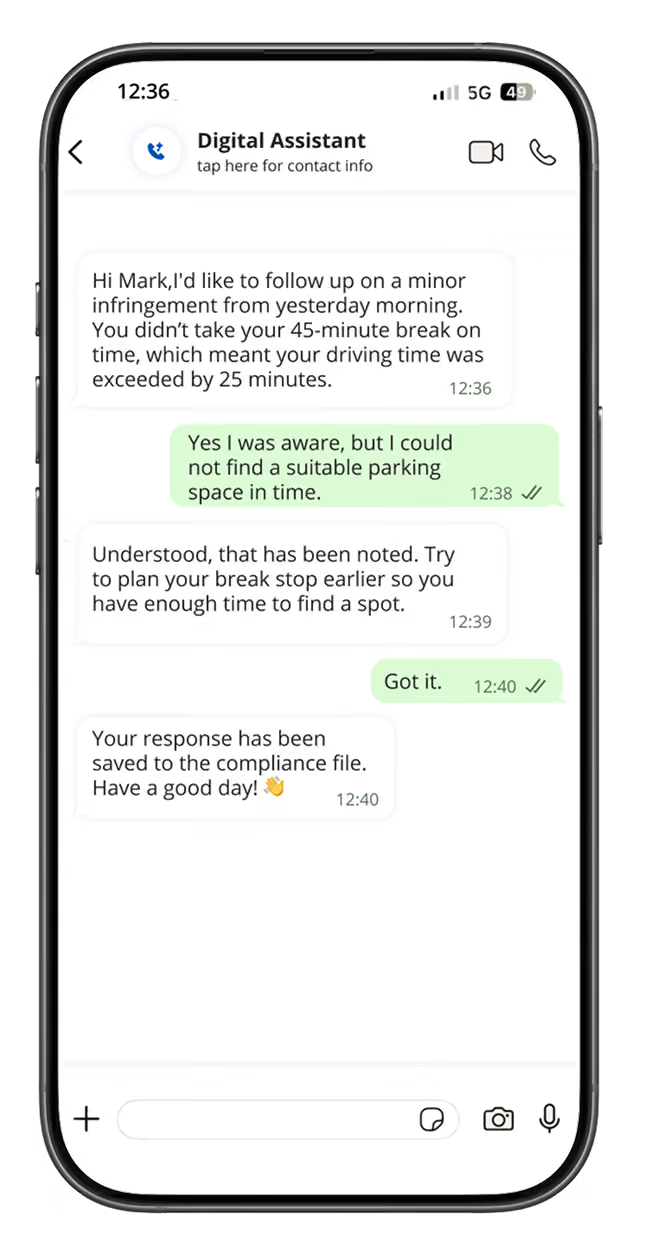
- Make your follow-up provable. Discuss every infringement with the driver, record what you agree and check whether things improve. Doing this by hand takes hours. Roadsoft's WhatsApp Assistant sends the driver an explanation the day after an infringement, with a short video, and logs the driver's reply in your records automatically
- Treat every letter as a deadline. Check the details and, if in doubt, have it reviewed straight away by a solicitor experienced in transport law
Key takeaways
- Since 1 January 2026 the UK has been reconnected to ERRU, so serious infringements by UK operators in the EU can be reported home
- Infringements are graded as serious, very serious or most serious, and only final penalties count
- There are no ERRU points in Great Britain: Traffic Commissioners judge repute case by case, with the frequency rule of 3 VSIs per vehicle per year as a benchmark
- OCRS helps decide how often DVSA stops you, and a red traffic score means more encounters
- Paying on the spot abroad usually makes a fine final, while a deposit keeps a challenge open
- Loss of repute is not automatic: for most serious infringements, the Traffic Commissioner must weigh proportionality
- At a public inquiry, what counts is proof that you organise work properly, instruct drivers and check compliance regularly
The risk is not the fine, it's the total
A single fine stings, then passes. Infringements that pile up, travel across borders and land on a Traffic Commissioner's desk are a different matter. Operators who know how infringements add up, take every letter seriously and can show what they do about them keep the numbers down. If they are called to a public inquiry, they arrive with evidence in hand.
Want follow-up you can prove without losing hours every week? See how the WhatsApp Assistant explains an infringement to the driver and logs the conversation automatically.

Frequently asked questions
Yes. The UK was disconnected after Brexit and reconnected from 1 January 2026 under the UK-EU Trade and Cooperation Agreement. Serious infringements by UK operators in the EU can now be reported to UK authorities through ERRU.
No. Points systems with fixed limits exist in some EU countries, such as the Netherlands. In Great Britain, Traffic Commissioners judge repute case by case, guided by the Statutory Documents and the frequency rule in Regulation 2016/403.
It can. A final penalty for a serious infringement can be reported to the UK through ERRU, and Traffic Commissioners can take penalties in the EU into account when looking at repute.
The Operator Compliance Risk Score is DVSA's system for deciding which vehicles to inspect. It does not decide repute, but a red score means more roadside encounters. You can view your OCRS reports online with a Vehicle Operator Licensing account on gov.uk.
Yes. A transport manager who loses repute is disqualified for at least a year and must complete training or pass an exam before being rehabilitated.