UK van tachograph compliance checklist: 30 actions before 1 July 2026
.jpg)
From 1 July 2026, every UK operator running vans above 2.5 tonnes MAM on international hire and reward journeys between the UK and the EU falls within the same tachograph regime that already governs HGVs. Whether you're ready depends on 30 concrete actions across six domains: fleet, hardware, cards, drivers, back-office records and policy. This van tachograph checklist UK works through each one, telling you what to tick and what to do if it's open. Print it, work through it, and know where you stand for every vehicle in scope.
How to use this checklist
For each item below: tick if done, circle if open. Walk through it once to establish the current position, then weekly to track progress. The six blocks follow the logical order of implementation: first you know what's in scope, then hardware, then cards, then people, then process, then policy.
A reminder on UK scope: the 2026 change applies only to vehicles above 2.5 tonnes MAM used for UK to EU hire and reward journeys. Own-account international and UK-domestic operations between 2.5 and 3.5 tonnes are not pulled into the new regime. For those operations, the existing UK position holds. The checklist below assumes vehicles within the new scope.
Block 1: Fleet mapping (5 actions)
Which vehicles fall in scope, and which don't?
- All vehicles categorised by MAM from the V5C, marked above or below 2.5 tonnes
- For every vehicle above 2.5 tonnes, journey profile recorded: UK-domestic, UK to EU, or cabotage
- Combinations calculated: van plus trailer above 2.5 tonnes combined MAM
- Exemption claims checked and documented: 100 km artisan exemption, sector exemptions under Article 13 of retained Regulation (EC) 561/2006
- Final in-scope list compiled: which vehicles need a Smart Tachograph 2 fitted
Outcome: a single document with in scope, out of scope, or borderline marked per vehicle. Borderline cases get specialist advice or a direct DVSA query.
Block 2: Hardware ready (5 actions)
Installation has the longest lead time of any item on this checklist.
- Quote requested for each in-scope vehicle at a DVSA-approved tachograph centre, not a general workshop
- Installation appointments booked: at least three months before 1 July 2026
- Smart Tachograph 2 fitted and lock-in completed with the company card, confirmed per vehicle
- Calibration date recorded: next calibration scheduled two years out in the diary
- Procedure for in-flight tachograph failure documented: at most seven days to repair at an approved centre, with the driver maintaining manual records in the interim
Outcome: every in-scope vehicle is fitted and calibrated before 1 July 2026.
Block 3: Card applications (5 actions)
Cards are issued by DVSA with a typical processing time of a few weeks, longer around deadline pressure.
- Driver list compiled: every driver who could operate an in-scope vehicle, including those who only do occasional international work
- Driver card application submitted by each driver through DVSA, encouraged at least four to six weeks before the deadline
- Company card applied for through DVSA: at least one, more for multi-site or larger operations
- Card receipt confirmed per driver and per company card before 1 July 2026
- Procedure for lost or defective cards documented: driver knows the 15-day rule with manual records, operator knows the replacement application process
Outcome: every driver who could operate an in-scope vehicle on 1 July 2026 has a valid driver card, and the operator has at least one working company card for downloads.
Block 4: Driver training (5 actions)
DVSA does not treat driver ignorance as reduced operator culpability. The operator carries the training duty.
- Written instruction card per vehicle: daily mechanics, country code, activity modes, what to do at a roadside check
- All drivers trained before their first tachograph journey, including drivers who only do occasional international work
- Drivers briefed on the 56-day roadside check rule: they know which records will be examined
- "Card out at end of shift" policy communicated: prevents forgotten end-of-day country codes
- Force majeure and home-base derogation rules explained: drivers know when extended driving time is permitted and how to record it
Outcome: drivers don't make avoidable mistakes on day one.
Block 5: Records and back-office (5 actions)
From 1 July 2026 the regulatory clocks start. The download and analysis routine has to be in place by then.
- Download procedure in place: manual or remote, with named responsible person
- Download frequency embedded in routine: driver card no more than every 28 days, vehicle unit no more than every 90 days
- Retention policy in place: at least 12 months for tachograph data, at least 24 months for Road Transport (Working Time) Regulations 2005 records
- Tachograph analysis software live: data is tested against the same control points DVSA uses at a Desk-Based Assessment
- Responsible person nominated for infringement follow-up: planner, fleet manager or logistics coordinator carrying the routine
Outcome: the first download deadline after 1 July is met, and every flagged infringement gets actioned.
Block 6: Policy and ongoing compliance (5 actions)
1 July 2026 isn't the end-state. It's the start of a routine that runs in perpetuity.
- Internal tachograph compliance policy written down: how the operation is organised, who's responsible, escalation paths
- Weekly routine fixed: download check, infringement analysis, driver follow-up
- Monthly download audit: every card and VU downloaded on time, every file complete
- Annual review: instructions current, regulation updates absorbed, policy still fits the operation
- Audit trail maintained: debrief records with drivers, analysis reports, follow-up actions retained for at least the regulatory retention period
Outcome: at any DVSA roadside encounter, Desk-Based Assessment, or Operator visit, you can evidence that compliance is structural, not episodic.
What to do this week
Three actions to turn this van tachograph checklist UK into a working delivery plan, not a static document.
Print the checklist and walk it through for one vehicle this week to size the work realistically. Then scale across the in-scope fleet.
Set the three pillars of tachograph compliance (download, analyse, follow up) as the benchmark for blocks 5 and 6. An operator that downloads but doesn't analyse and follow up ticks the checklist but fails at a Public Inquiry. The audit trail across all three pillars is what reduces culpability at any DVSA encounter.
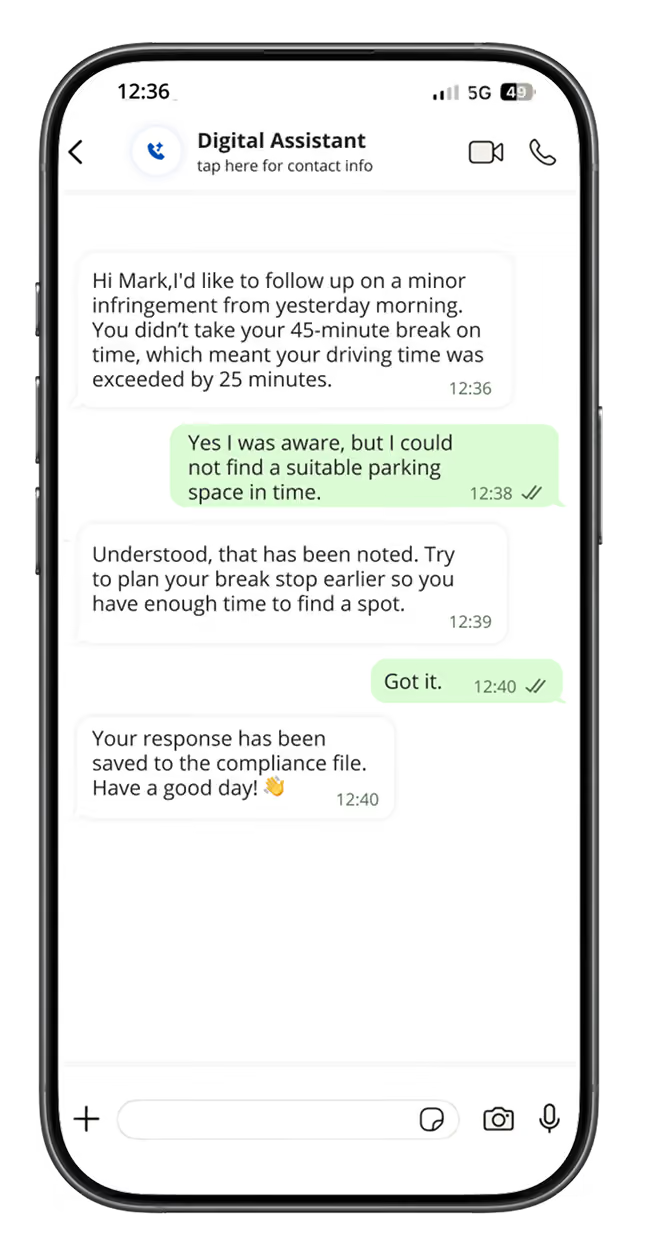
Pair the checklist with software that supports the routine. Roadsoft's tachograph analysis software tests C-files and M-files against the control points DVSA uses at a Desk-Based Assessment. The Task Manager translates every flagged infringement into a concrete task for the responsible planner or driver, and holds the audit trail. The Digital Assistant supports driver debriefs through WhatsApp or voice, so the conversation gets logged rather than lost in a spreadsheet. Roadsoft positions itself as the partner for everything that comes after installation: the day-to-day data management, the analysis, the reporting, the audit trail that holds up when DVSA arrives at the gate.
Key takeaways
- The van tachograph checklist UK covers 30 actions across six blocks: fleet mapping, hardware, cards, drivers, records and policy
- Installation at a DVSA-approved tachograph centre (three months ahead) and DVSA card applications (six weeks ahead) carry the longest lead times and should come first in the planning order
- The 2026 change applies only to UK to EU hire and reward at above 2.5 tonnes MAM; own-account international and UK-domestic operations are not affected by the new threshold
- A fitted Smart Tachograph 2 and valid driver and company cards are the minimum requirements for a vehicle to operate from 1 July 2026; everything else on the checklist drives down infringement risk
- The three pillars (download, analyse, follow up) determine whether the checklist works in practice or just gets ticked
- The checklist is a snapshot, not a one-off: revisit annually and at any material change in fleet, drivers or regulation
Where to start
The van tachograph checklist UK is a working document, not an administrative exercise. It decides whether a van operation can credibly cross the UK-EU border from 1 July 2026 onwards. The win sits in starting now: fleet mapped this week, installation slots booked next week, card applications submitted the week after. Operators acting in good time hit the deadline with margin. Those leaving it until spring 2026 run into waiting lists at calibration centres and at DVSA, and the room for error narrows fast.

Frequently asked questions
Realistically six to eight weeks of elapsed time, provided work starts now. Fleet mapping takes a day. Booking installation slots takes a week of phone calls. Installations themselves take three to four weeks depending on calibration centre availability. Driver and company card applications run for four weeks in parallel. Driver training and back-office setup take two to three weeks in parallel.
Those specific vehicles can't make UK to EU hire and reward journeys from 1 July onwards. An in-scope vehicle without a working Smart Tachograph 2 attracts fines and prohibition risk at any roadside encounter. Calibration centres' waiting lists tighten as the deadline nears, so deferring deepens the problem.
Action 8 (Smart Tachograph 2 fitted with lock-in) and actions 12 to 14 (cards in hand) are stoppers: without them, the vehicle can't run. Actions 22 to 24 (download frequency, retention, analysis) carry the highest infringement risk after 1 July: missed downloads are visible at every roadside encounter and trigger fixed penalties.
One general instruction document satisfies the minimum, provided you can show each driver has received and understood it. A signature on receipt, plus a short briefing for new drivers at induction, is what holds at a Public Inquiry.
Annually as a minimum, plus at every material change: a new or removed vehicle, a new driver, a regulation update, a change of approved tachograph centre. A January refresh aligned to the business planning cycle works well.