How to comply with the new tachograph rules for vans in the UK

From 1 July 2026, UK operators running vans from 2.5 tonnes MAM on international hire and reward journeys between the UK and the EU come into the same tachograph regime that already governs HGVs. For the LCV couriers, parcel businesses and specialist hauliers caught by the change, that means installing Smart Tachograph 2 hardware, issuing driver and company cards through DVSA, training drivers who have never operated a tachograph, and standing up a download and analysis routine that satisfies DVSA at any Desk-Based Assessment. The compliance work breaks down into five steps before the deadline, and a steady rhythm of weekly and monthly tasks after it. Leave it until spring 2026 and waiting lists at DVSA-approved calibration centres and at DVSA card processing will narrow the options.
What changes on 1 July 2026 and who's actually in scope?
The threshold for the EU drivers' hours and tachograph regime drops from 3.5 tonnes to 2.5 tonnes MAM. The basis is Regulation (EU) 2020/1054, retained as UK law for cross-border purposes, amending Regulation (EC) 561/2006 (drivers' hours) and Regulation (EU) 165/2014 (tachographs). The Court of Justice of the European Union confirmed the lawfulness of the regulation on 4 October 2024.
For UK operators, the change has a narrower bite than the EU figure suggests. The new threshold catches vehicles only when three conditions apply at the same time: MAM above 2.5 tonnes (including any trailer), hire and reward work, and a journey crossing into the EU or involving cabotage in an EU country. Miss one, and the operation stays outside the 2026 change. Own-account international transport and UK-domestic operations between 2.5 and 3.5 tonnes are not affected by the new threshold.
A handful of exemptions sit in Article 3 and Article 13 of retained Regulation (EC) 561/2006, including 100 km radius operations for specific trades and sector exemptions for agriculture, but none apply automatically. They need to be evidenced at any roadside encounter.
Five steps before 1 July 2026
Operators landing in scope of the new tachograph compliance for vans UK regime have five practical steps to complete. The order matters: step 1 decides which vehicles are in, steps 2 and 3 carry the longest lead times, and steps 4 and 5 only make sense once the first three are done.
Step 1: Map your fleet. For every vehicle you operate, note the MAM from the V5C, the journey profile (UK-domestic, UK to EU, cabotage), and whether the work is hire and reward or own-account. The output is a simple list: in scope, out of scope, or borderline. Do this now, not in April. The list drives everything else.
Step 2: Book Smart Tachograph 2 installation at least three months before the deadline. Every in-scope vehicle needs a Smart Tachograph 2 (ST2) fitted and calibrated by a DVSA-approved tachograph centre. Calibration by any other workshop isn't valid. After installation, the unit is locked into your operation using your company card. The unit then needs recalibration every two years. Van installations are technically more involved than HGV installations, and waiting lists at approved centres will lengthen as the deadline approaches. An installation slot in April or May is realistic; June is risky.
Step 3: Apply for driver cards and a company card through DVSA at least six weeks before the deadline. Two types of card are needed. The driver card is personal, applied for by each driver through gov.uk under the DVSA driver card service. Standard delivery is typically a few weeks, but pressure rises around the deadline. Drivers without a card on 1 July 2026 cannot legally drive an in-scope vehicle. The company card is applied for by the operator, also through DVSA, and is used for the install lock-in and for downloading data. Apply in April or May, not June.
Step 4: Train your drivers before their first tachograph journey. A driver who's never operated a tachograph and isn't trained is a liability for the operator. DVSA does not treat ignorance as reduced culpability because the operator carries statutory responsibility for driver instruction. The training has to cover the daily mechanics (card insertion, manual entry, country code at start and end, the four activity modes), the drivers' hours rules under retained Regulation (EC) 561/2006, what happens at a roadside encounter, and how to handle a lost or defective card.
Step 5: Set up the download and analysis routine before the first download deadline runs out. From 1 July 2026 the regulatory clocks start. The driver card must be downloaded at least every 28 days. The Vehicle Unit (VU) at least every 90 days. Tachograph data must be retained for at least 12 months under retained Regulation (EU) 165/2014, and working time records for at least 24 months under the Road Transport (Working Time) Regulations 2005 (RT(WT)R). Without a routine in place, the first 28-day deadline catches operators out within a month of starting.
What goes right and wrong day to day and month to month?
Before 1 July is a project. After 1 July it becomes a routine, and three patterns of error are common enough to plan around.
The most frequent daily error is the forgotten country code. At the start and end of every shift, the driver enters the start and end country, even on a fully domestic day. Missed country codes are graduated fixed penalty offences and visible at every roadside check. A Smart Tachograph 2 paired with a G2V2 driver card auto-records country codes at border crossings, but the start-of-day and end-of-day entries remain manual.
The second is the wrong activity mode at stops. A driver loading or unloading with the tachograph set to "rest" creates a registration error, even when the misuse isn't intentional. A driver stopping for a break who doesn't switch to "rest" produces a stop that doesn't count as a legal break, and the 4.5-hour driving clock keeps running.
The third is the back-office failure: missed downloads. Driver cards left longer than 28 days without a download, or VUs left longer than 90 days, fall foul of retained Regulation (EU) 165/2014. At a roadside check, whether a card has been downloaded recently is visible to the traffic examiner from the tachograph itself. A roadside encounter is not only a check on the driver's hours, it's also a snapshot of the operator's compliance evidence.
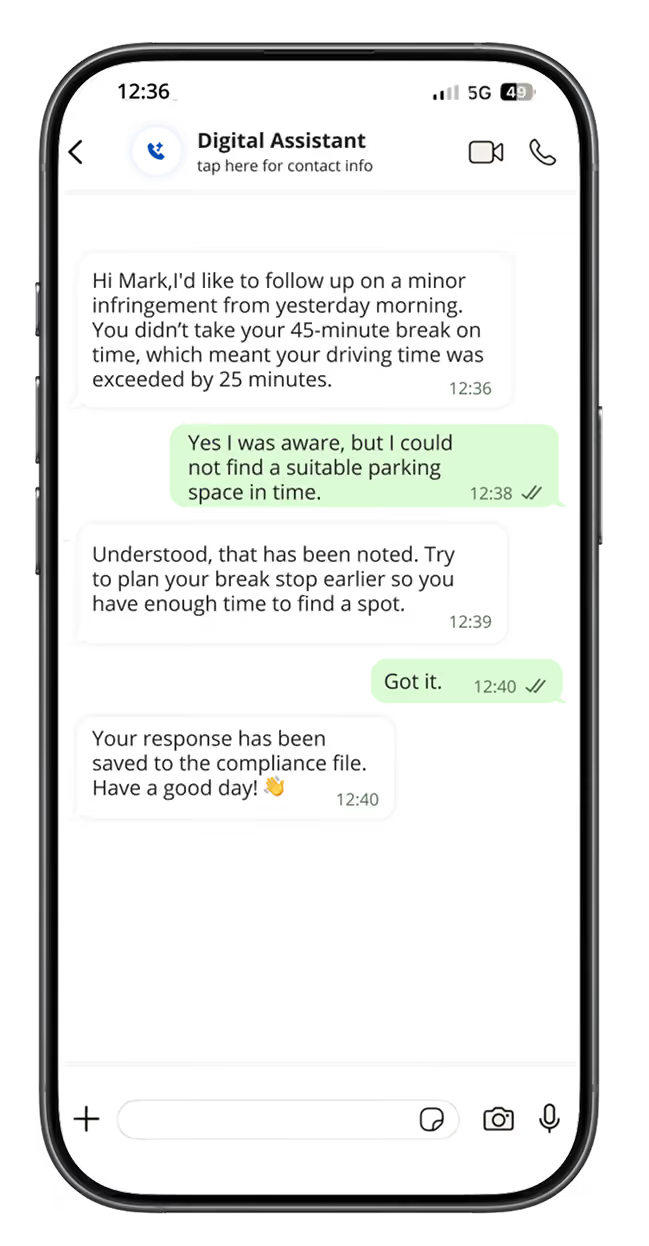
Three pillars run through all three patterns: download the data, analyse it, follow up with drivers on infringements. An operator that downloads but doesn't analyse only finds out about infringements when DVSA does. An operator that analyses but doesn't act on driver-level patterns sees the same infringements repeat every month.
What to do this week
Three actions before booking installation slots and applying for cards.
Build the in-scope list. Pull V5Cs, note MAM per vehicle, mark the operations that touch UK to EU hire and reward. Twenty minutes of work that determines everything that follows.
Call a DVSA-approved tachograph centre. A non-commercial conversation: ask for an indicative quote, current waiting times, what's needed at installation. You don't have to commit yet. You'll get a realistic feel for the timeline.
Decide who in your business carries the tachograph compliance role. It doesn't have to be a specialist. A traffic planner, a fleet manager or a logistics coordinator can hold it, as long as there's a recurring slot for download and analysis follow-up.
For the analysis and follow-up work, Roadsoft built tachograph analysis software and the Task Manager. The analysis software reads C-files (driver card data) and M-files (vehicle unit data) and tests them against the same control points DVSA uses at a Desk-Based Assessment. The Task Manager turns each flagged infringement into a concrete task for the responsible planner or driver, with the audit trail attached. You can rebuild the same routine in spreadsheets, but a DBA assessment doesn't only want infringements identified, it wants them acted on and recorded. The audit trail is what reduces culpability if DVSA finds something.
Key takeaways
- Tachograph compliance for vans UK takes effect on 1 July 2026 for vehicles above 2.5 tonnes MAM on UK to EU hire and reward journeys, under retained Regulation (EU) 2020/1054
- Five steps complete the readiness work: map the fleet, install a Smart Tachograph 2 at a DVSA-approved centre, apply for driver and company cards through DVSA, train drivers, and stand up the download and analysis routine
- Lead times sit at installation (three months before deadline) and DVSA card applications (six weeks); both will tighten as 1 July 2026 approaches
- After 1 July, the rhythm is daily (country codes, correct activity modes) and periodic (driver card every 28 days, VU every 90 days, 12-month retention for tachograph data, 24 months for RT(WT)R records)
- The Court of Justice of the European Union confirmed the underlying regulation on 4 October 2024; the deadline is fixed
- Compliance rests on three connected steps: download the data, analyse it, follow up with drivers. Missing any one leaves DVSA exposure even when the other two are working
Where to start
The new tachograph compliance for vans UK regime is a substantial change for operators who have never run a tachograph before. The rules are detailed, DVSA enforcement is active, and the cost of a structurally non-compliant approach lands in fines, OCRS-driven Red banding, and eventually licence-level scrutiny. The simpler the routine, the better it holds: install the right hardware on time, apply for cards in good time, train the drivers, download and analyse the data on schedule, and act on the patterns. Operators booking installation slots and card applications now have the easiest path to the deadline.

Frequently asked questions
Yes. Frequency is irrelevant. Every international hire-and-reward journey above 2.5 tonnes MAM falls under the rules from 1 July 2026, including occasional trips. The vehicle has to be Smart Tachograph 2 fitted and the driver has to hold a valid driver card before the first journey.
For vehicles between 2.5 and 3.5 tonnes MAM running exclusively in the UK on hire and reward, or any work below 3.5 tonnes on own-account terms, the new threshold doesn't apply. Above 3.5 tonnes, the existing UK and EU rules apply as they always have. Mixed UK-domestic and international work on the same day usually means the cross-border rules apply for the entire day.
Both. The driver is responsible for correct tachograph operation and can be issued a fixed penalty at a roadside check. The operator is required to plan work so the driver can comply, and is responsible for the back-office records and driver training. A scheduling pattern that systematically leaves no margin for delay shifts blame to the operator at a Public Inquiry.
Then those vehicles can't make UK to EU hire and reward journeys from 1 July 2026 onwards. Driving an in-scope vehicle without a working Smart Tachograph 2 attracts fines and prohibition risk. Approved centres' waiting lists tighten as the deadline nears, so deferring the booking deepens the problem rather than easing it.
At least 12 months for tachograph data under retained Regulation (EU) 165/2014. At least 24 months for working time records under the Road Transport (Working Time) Regulations 2005. Most operators retain longer to support investigations and longer-running audits.